
Kverneland Cultivator & Tine Technology for Better Agronomic Results
We believe: “Soil is Farmers’ most valuable asset”
Optimum plant growth depends on the complex structure of physical, chemical and biological soil properties.
Cultivators for Every Soil, Every Season
The Kverneland Enduro stubble cultivator and the Kverneland Turbo universal cultivator combine innovative tine technology with premium steel quality and intelligent knock-on share systems. This proven combination ensures excellent soil penetration, reliable residue incorporation, consistent working depth, and outstanding durability, while keeping maintenance time to a minimum.
With a wide selection of tines, shares, wings, and rollers, every cultivator can be configured to suit specific soil types, crop residues, and cultivation objectives. From conservation tillage and minimum tillage to conventional seedbed preparation, Kverneland cultivators deliver high performance, low operating costs, and maximum efficiency in the field.
Whatever the challenge, Kverneland offers the right solution to maximise the potential of every hectare.
Soil and Agronomics
Soil structure, the physical configuration:
A healthy soil structure is the vital basis for water management, nutrients supply and soil carbon sequestration.

Compacted soil layers restrict root development, reduce water infiltration and limit nutrient supply.

Compacted soil layers restrict root development, reduce water infiltration and limit nutrient supply.
Maintaining a healthy soil structure is the prerequisite for successful farming today and in the future. Stubble cultivation, especially within a minimum tillage cultivation program, conserves soil structure and moisture and limits erosion. It is an operation which requires great consideration.
Supporting the soil structure
The first stubble cultivation after harvest supports the stable soil structure. Improved consolidation of the surface and deep incorporation of residue assists in the control of pests such as slugs or mice by restricting their movement in the seedbed to the surface. Whereas compacted soil layers restrict root development, reduce water infiltration and limit nutrient uptake.
Targeted loosening improves:
- Root penetration
- Soil aeration
- Water movement
- Biological activity
Soil loosening should be achieved without excessive soil disturbance or unnecessary fuel consumption. Disturbed soil structures may increase the risk for erosion and loss of soil moisture. Soil management practices can accelerate the release of carbon from the soil while others increase the soil’s capacity to store it. The higher organic matter of the soil, the more carbon and water can be absorbed.
Soil, Residues Management and Crop Establishment
Every cultivation pass influences the next crop. The way residues are mixed, weeds are controlled, soil is loosened and moisture is conserved determines how successfully the following crop establishes and performs.
Modern cultivation and tillage is, therefore, much more than soil movement. It is about preparing the optimum conditions for biological activity, nutrient availability, root development and seed placement.
Organic matter: a reservoir of nutrients and water
Following harvest, crop residues represent a valuable source of organic matter and nutrients. However, residues only contribute to soil fertility when they are effectively incorporated into the soil and exposed to biological decomposition. Therefore, successful residue management accelerates decomposition into humus

Negative example: Residue not mixed within soil profile
- Restrictive layer, a barrier for water, air and nutrients
- Residue not easily decomposed

Positive example: Residue evenly mixed within soil profile
- Easy flow of water, air, nutrients
- Supports decomposition of residue to improve organic matter and soil structure
- Positive root development
Successful Residue Management
- Intensive mixing of residues and soil
- Uniform distribution across the working width
- Good soil-to-residue contact
- Consistent working depth
The Kverneland Solution
With the Enduro and Enduro Pro, Kverneland offers a stubble cultivator for all conditions and for a wide range of applications. The Enduro range excels by its advanced tine technology and can be equipped with Triflex 700 and shear-bolt tines. Both specially heat-treated hollow tines have the same special angles and can “flex” a certain way around obstacles and erase stress peaks by dispersing it throughout the implement.
The Triflex 700 Tine Technology
The auto-reset Triflex 700 tine uses the well-known Kverneland leaf spring system to ensure a high point pressure of 700kg in work and a smooth release curve when the tine hits an obstacle. The hollow, specially heat-treated tine has a narrow design and special shape which reduce the pulling forces while ensuring a perfect penetration even in heavily compacted soil. It is the perfect choice for deep loosening and working on heavier soil types with stones.
Both the Triflex 700 and shear-bolt tines can be equipped with different shares to provide maximum flexibility for varying depth and soil disturbance. It is important to choose the right option for the required task and working depth.

A large range of share designs are available with the Knock-on® system. This is the easiest way of exchanging parts on a cultivator, either to adapt the machine to the job to be done or to change wearing parts.
The result:
- Improved rooting conditions
- Enhanced water infiltration
- Reduced compaction effects
- Better crop resilience during dry periods
- Balancing cultivation benefits and soil disturbance
Kverneland Turbo with Triflex 400 and Reflex tine technology
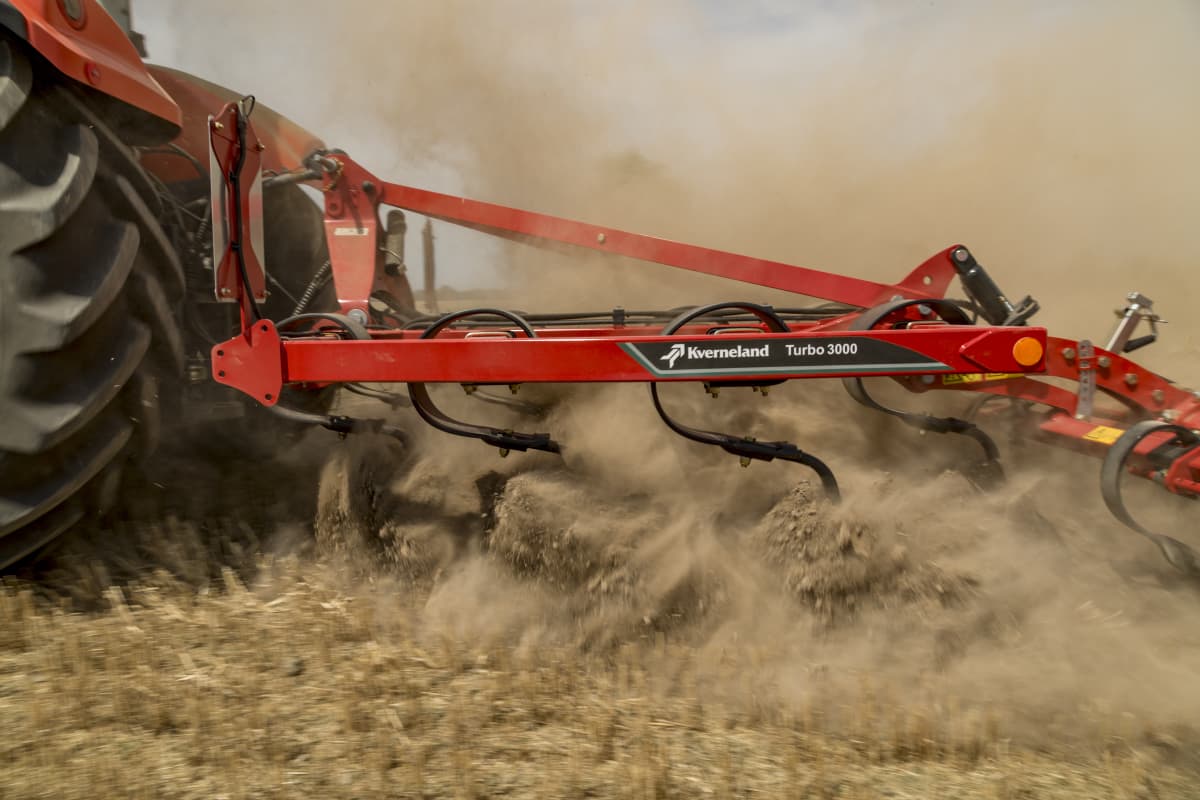
The universal cultivator Kverneland Turbo with Triflex 400 and Reflex tine technology for efficient soil cultivation and seedbed preparation
The Kverneland Turbo is the universal cultivator for efficient soil cultivation and seedbed preparation at working depths from 3 to 20cm at high forward speeds.
Two tine options adapt the Turbo to a wide range of tasks:
• Reflex Tine – Designed for versatility, this tine delivers high vibration for intensive mixing and crumbling in all soil types. Compatible with a variety of shares, it allows first/second cultivation as well as seedbed preparation.
• Triflex Tine 400 – Built for stony soils and demanding conditions, this robust tine provides excellent penetration and stability. It also supports multiple share types for depth and task adaptability.
Reflex Tine Technology
High vibration, narrow spacing, efficient crumbling
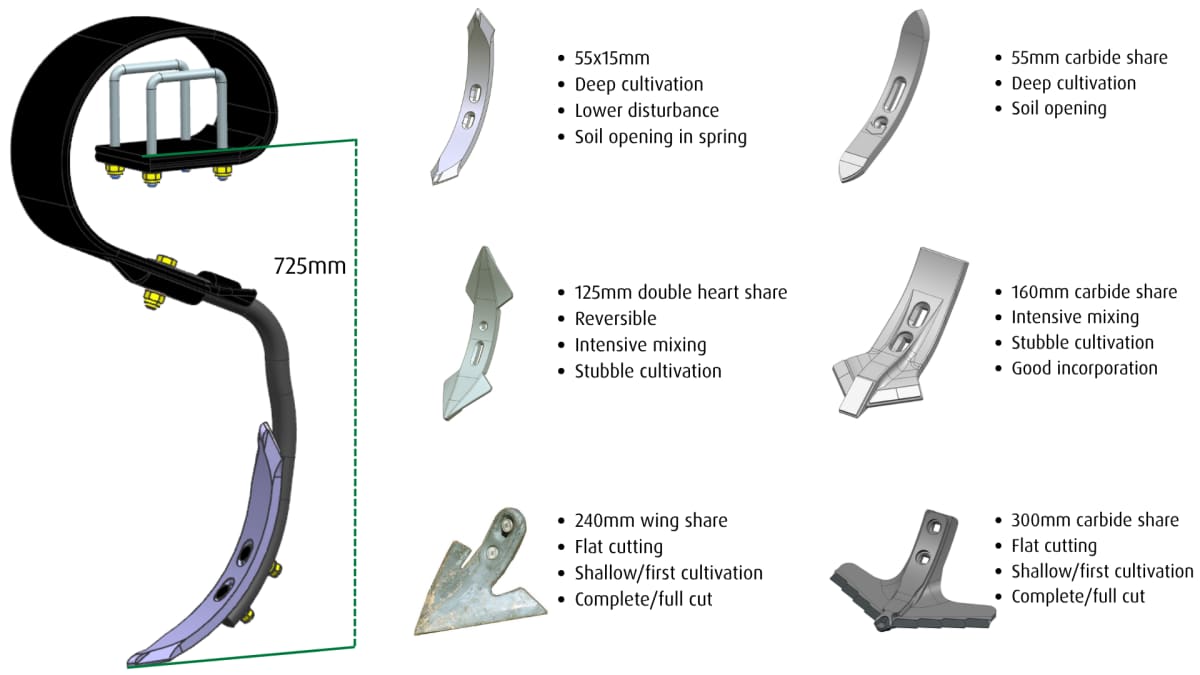
The Reflex tine benefits from high vibration effect: the large coil and the high tine clearance of 725mm gives a high flexibility whilst ensuring a high vibration effect to crack the clods and mix the soil. An even working depth of the share is maintained even when the tine releases to the back. The narrow tine spacing ensures active crumbling and perfect levelling. Thus, the pressure applied on the coil is reduced to extend its life time.
The Reflex tine is the perfect solution for using the Turbo in first/second stubble pass or for seedbed preparation, as well as for the incorporation of slurry or manure. To make it even more flexible, three different shares are available to provide maximum flexibility for varying depth and soil disturbance. Three options of carbide shares are available, to increase farmers’ productivity.
Designed for versatility and intensive soil refinement, the Reflex tine delivers
- Active vibration effect
- Narrow spacing
- Intensive mixing and crumbling
- Low draft requirement
- Consistent cultivation depth, deep and shallow
The Reflex tine is ideal for:
- Seedbed preparation
- Secondary cultivation
- Residue incorporation
- Shallow cultivation
Triflex Tine 400
High vibration, narrow spacing, efficient crumbling
For stony conditions and high penetration, the Triflex tine 400 offers high stability at deeper operations.
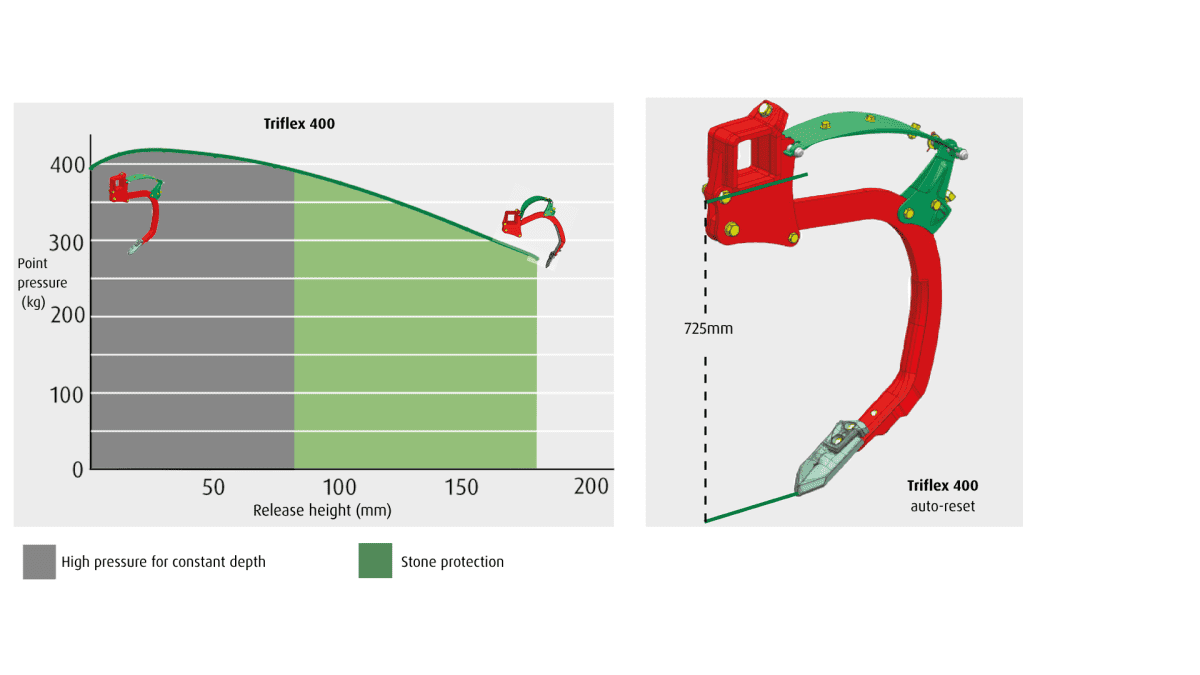
As the auto-reset Triflex 700 of the Enduro, also the Triflex tine 400 uses the well-known Kverneland leaf spring system to ensure a high point pressure of 400kg in work (in comparison to the release force of 700kg with the Triflex tine 700) and a smooth release curve when the tine hits an obstacle. The Triflex tine with narrow design and special shape reduces the pulling forces while ensuring a perfect penetration in most compacted soil. It is the perfect choice for deep loosening and working on heavier soil types strewn with stones.
With a full range of different shares available and the patented Knock-on® system, the Triflex Tine 400 is quickly adjusted to all sorts of operations, The Triflex Tine 400 is ready to operate to adapt to different working depths and tasks.

The proven Kverneland leaf-spring design combines strength and flexibility.
Benefits include:
- 400kg release force
- Proven overload-protection
- Intensive mixing and crumbling
- Constant cutting depth with a full range of shares, deep and shallow
- Knock-on system for fast share exchange
Related products: The Kverneland Cultivator range
Why Kverneland Tine Technology?
Every agronomic objective starts below the surface.
By combining advanced tine design, premium steel quality and flexible share technology, Kverneland cultivators help farmers create the optimum conditions for soil health, residue management and crop establishment.
The result is a cultivation system that not only moves soil, but actively contributes to improved crop performance, operational efficiency and long-term soil productivity.
Knock-on® Quick Exchange System
Maximum Flexibility
Different field conditions require different cultivation tools. The Knock-on® quick exchange system allows operators to adapt the machine quickly and efficiently without lengthy downtime.
Fast Share Changes
The simple locking mechanism enables rapid replacement of worn or alternative shares directly in the field.
Adapt the cultivator to the task
Different share designs support different agronomic objectives:
Full-Width Cutting Shares
Best suited for:
• Weed control
• Stale seedbeds
• Shallow cultivation
Mixing Shares
Best suited for:
• Residue incorporation
• Cover crop destruction
• Organic fertilizer incorporation
Narrow Points
Best suited for:
• Deep loosening
• Compaction management
• Improved drainage
The ability to switch quickly between these options ensures the cultivator remains optimized for every operation throughout the season.
The wide range of shares in combination with the Knock-on® quick exchange system enables the Kverneland cultivators to be adapted quickly for different tasks and requirements.
Related products: The Kverneland Cultivator range
Discover all Kverneland stubble cultivators
Discover all Kverneland universal cultivators
What farmers say about the Kverneland Enduro
See Kverneland Enduro proving its worth for Wexford Grower